Speed bumps are a tried and tested way to bring traffic to a crawl. As a seasoned traffic calming expert with years of experience helping local authorities, businesses, schools and housing estates across the UK keep their streets safer, I’ve seen just how much of a game-changer they can be.
Speed management is a serious issue in the UK, where a staggering 40% of road deaths are pedestrians and cyclists. The Department for Transport figures make for sobering reading – at 30mph pedestrian survival rates are just 9%, but jump to over 90% at a more leisurely 20mph. So, what can be done to keep vulnerable road users safe? That’s where vertical traffic calming measures like speed bumps come in.
In this article we’ll cover the different types of traffic calming devices used on UK roads – speed bumps, humps, cushions and tables – as well as the UK laws surrounding their use, where to put them, how to buy and install them, and what the future may hold.
How Speed Bumps Actually Work and Their Benefits
The basic principle is simple: vertical deflection forces drivers to slow down to avoid jarring their suspension (or getting a nasty shock). When a car hits a raised ridgeline at too high a speed, the bumping forces on the suspension prompt a driver to start braking earlier than they would have otherwise, and to be more watchful of pedestrians and other road users.
For those in charge of, say, a hospital car park or business estate, you’ll need to know that the typical geometries used for UK-style traffic control bumps involve three different heights:
- 50 mm: This is the ‘gentle persuader’ option, aiming for around 10 mph speeds
- 60 mm: This one’s a bit more in-your-face, targeting intermediate speeds
- 75 mm: This is the ‘we mean business’ option, aimed at keeping drivers at a flat-out 5 mph
Now, speed bumps can change driver behaviour big time. Cars will brake 20-30 metres earlier, approach pedestrian crossing points more cautiously, and pedestrians are much less likely to get mugged by a speeding driver when turning into residential streets – down 18% on average, in fact.
To get the most out of them, the best strategy is to install the devices in a series, spaced out at 60-100 metres, to stop cars speeding up between them. However, if the devices are too aggressive or poorly sited, expect a barrage of complaints from residents about noise from harsh braking, vibrations through nearby buildings, and the ‘cat-astrophic’ costs of replacing damaged tarmac.
Traffic Calming Devices – Speed Bumps, Humps and More
Be honest – you’ve probably called them ‘speed bumps’ without really thinking about it, but the truth is, there are actually different types of traffic calming devices for different jobs. On private land, like car parks and industrial estates, you have a bit more leeway than on public highways. But it’s great to know your options.
Traditional Speed Bumps (The Sleeping Policemen)
These are the classic ‘sleeping policeman’ style bumps – narrow and long, typically 300-400 mm across in the direction of travel. They’re designed to bring traffic to a complete halt at around 5-10 mph. Common spots for these include:
- Private car parks
- Industrial estates
- Hospitals and shopping centres
- Residential developments
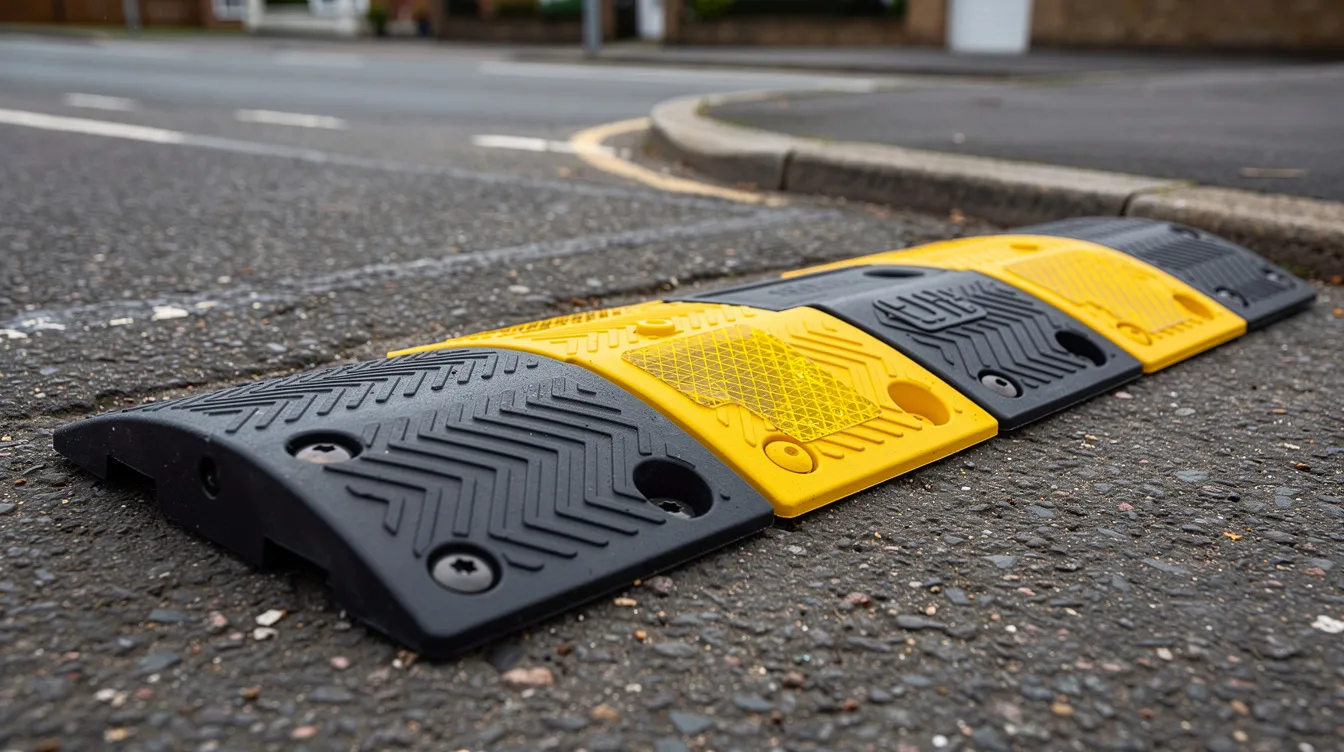
The beauty of speed bumps is that they’re often made from pre-formed recycled rubber or PVC, which makes them a cost-effective solution. Most come in kits with end caps and mid-sections in bright black and yellow colours with reflective goodies to keep drivers on their toes.
Pros: Effective at reducing speed, affordable (£50-100 per unit), easy to install without a lot of specialist kit.
Cons: Not great for buses and large vehicles, might get a bit noisy if overused.
Speed Humps
Speed humps are longer, snazzier features that cover the whole lane, usually 3.7-4.0 metres across. They’re designed to calm traffic at around 15-25 mph while still giving a smoother ride than those nasty sharp bumps.
Road humps on public highways need to comply with the Highways (Road Humps) Regulations 1999 and get those white triangle markings and advance warning signs. They’re perfect for residential streets in 20mph zones.
Studies in the UK and US have shown that, post-installation, 85% of drivers are cruising at 25-27 mph – quite a drop from the pre-hump days when 14% of drivers were exceeding the limit by 10mph or more. That’s like an 87% reduction in speeders – result!
Speed Cushions
Speed cushions are the most versatile of the lot – lower and wider than full-width humps, they slow cars and vans but let big vehicles like fire engines and buses straddle them without too much delay.
These are ideal for 20mph bus routes where emergency vehicles need to get a move on. They offer slightly less speed reduction than full-width humps, but a 30% speed boost for our emergency services heroes. Fire engines are 3-5 seconds quicker, ambulances with passengers get by in 10 seconds less.
Speed Tables and Raised Crossings
Speed Tables are long, flat-topped humps, usually 6-10 metres in length, with very gentle 1:20 ramps at either end and a flat bit in the middle. Speed Tables are basically long speed humps with a flat section in the middle which are designed to slow vehicles down without throwing them out of gear as much as traditional speed humps do; and they’re often used at pedestrian crossings. They reduce speed by a fair bit to around 20 mph but they’re a lot more comfortable to drive over and produce less noise than the old humps.
Common UK uses for them include:
- Junction entries and side road crossings
- Near schools as a raised zebra crossing
- Pedestrian-priority zones
The whole crossing being raised up makes pedestrians more visible to the traffic coming their way, and the crossing feels more like a continuation of the foot way. Raising the road level at crossings is one of the commonest ways to improve pedestrian visibility and safety.
Dynamic And Intelligent Speed Bumps
These newer traffic calming products only give a jolt to vehicles that are exceeding a trigger speed, leaving normal drivers to drive right on by as if nothing had happened. Systems using radar or hydraulic plates have been trialled in Sweden and Spain since the 2010s for instance.
The benefits include reduced noise and emissions compared to the static humps we used to have. However in the UK they have only been trialled in a few pilot schemes so far, mainly because they are a good deal more expensive (5-10 times more expensive), they need power to run and they require more maintenance than the old humps.
Materials and Construction of Speed Humps
The material you use for speed humps has a big impact on durability, performance, noise and the environment. On the public highway, speed humps that are going to be there for good are usually made out of asphalt or concrete, while private areas tend to use modular bolt-down systems. The permanent speed hump installations typically use asphalt or concrete for their durability, while the temporary or modular options often use recycled rubber or plastic for ease of installation and because they stand out well.
Asphalt and Concrete Speed Humps
They are built up in layers during the road surfacing process or retrofitted by planing off the top, and they offer.
- A service life of 20 years or more
- Excellent load capacity for HGVs and other big vehicles
- Seamless integration with the road surface
But they are a fair bit more expensive, costing £5000-£10,000 per site, and they do require the skills of a contractor and the use of some traffic management during the works.
Rubber and PVC Modular Speed Humps
The modular rubber speed humps are the ones that are used most on private land. The high quality speed humps that are used in the industry typically feature:
- Black and yellow colour schemes with reflective chevrons
- Pre-drilled fixing holes and end caps
- 50 mm and 75 mm bumps for different speed limits
- Heavy duty options with steel reinforcement for really heavy axle loads.
Installation only takes a couple of minutes per unit with SDS-drilled fixings, and a lot of the UK suppliers use high density recycled rubber to help get the material out of the landfill.
Metal and Other Specialist Speed Bumps
Metal or composite speed control plates are often used at temporary works areas and construction sites. They are removable and reusable but they do generate more noise under heavy traffic than some of the other types. There are some niche liquid filled systems that have been trialled in Spain that stiffen when driven over at speed but these are not yet common in everyday UK traffic calming.
 UK Regulations, Guidance and Legal Considerations
There is a bit of a legal distinction between measures on public highways and those on private land such as supermarket car parks or business estates.
Public Highway Requirements
Road humps in England and Wales are governed by the Highways (Road Humps) Regulations 1999 and any subsequent amendments. The Traffic Signs Regulations and General Directions 2016 set out the required road sign and marking specifications.
Highway authorities must have a chat with the police, the emergency services, and residents before installing any humps. There are height and spacing limits to be considered, and some areas are off-limits, near junctions and rail level crossings.
Some councils have actually removed humps after complaints – Derby’s mid 2000s removal programme cost over £500,000.
Private Roads, Car Parks and Commercial Sites
On private land, the Highways Regulations aren’t strictly applicable, but the people who own the land still have duties under health and safety and occupiers liability law. It makes sense to follow the DfT design principles anyway: appropriate profiles, conspicuous markings, and advance warning.
You might want to get some advice from your insurers and consider getting a highways consultant in to advise on bigger traffic volumes.
Signage, Markings and Speed Limits
Any physical devices must be supported by clear speed limits and traffic signs. Common UK signage includes:
- Warning triangles with hump symbols
- Supplementary plates stating distances
- White triangle markings on the humps
- Speed limit roundels in 20 mph zones
On private sites, using familiar sign designs will make it easier for drivers to understand what’s going on and will reduce your liability risk.
Planning, Designing and Locating Speed Humps
Successful schemes start with a clear problem statement: recorded speeding, collision history, or near miss reports. On public roads, you’ll need to have speed surveys and an analysis of the collision data over at least three years.
Site Assessment and Constraints
Before deciding on the location of the humps, inspect:
- The state of the carriageway and the drainage
- The lighting and visibility splays* Existing Traffic Patterns & Road Hazards
- Bear in mind key locations like bus stops, driveways, and pedestrian crossings – emergency services routes and access for large vehicles serving warehouses can also cause issues. Early consultation with stakeholders stops problems from arising down the line.
Picking Heights, Profiles and Spacing
On longer roads space out devices 50 to 100 metres apart. But match up ramp gradients to the type of vehicles that use them – softer for buses, steeper for roads used mainly by cars. You want to find a balance that works.
Minimising Disruptions & Air Quality Impacts
Noise from braking and increased pollution from stop-start traffic are common worries. There are ways to mitigate these issues:
- Using sinusoidal profiles (which is 10-15% quieter)
- Not placing devices outside bedroom windows so to reduce noise
- Combining physical measures with vehicle-activated warning signs to bring people’s attention to the issue
Installation, Maintenance and Safety
Even with a well-designed system, things can go wrong if the installation is botched or maintenance is neglected.
Installing Modular Rubber or PVC Speed Bumps
Here’s what you typically need to do to install them:
- Give the carriageway a good clean & mark the area
- Fix any potholes or cracking you find
- Lay out the mid-section & end caps to get the right length
- Mark & drill fixing holes with a drill bit
- Put in the anchors and make sure they’re tightened to the manufacturer’s specs
- Block one lane with cones while you work
- Get the signage up on the same day
Safety Checks & Ongoing Maintenance
Record all the details of the installation so you can check them later. Carry out a visual check every 6-12 months to make sure loose fixings, missing reflectors and settlement have not become a problem. If it’s cold outside, double-check for snow-plough damage.
Not Damaging Cars & Preventing Claims
If you install the devices properly, you will avoid damaged sumps and suspension. To make sure claims don’t happen:
- Make sure the devices are the right height
- Keep your markings very visible
- Get advisory speed plates up in time
- Have a clear process for handling complaints
Benefits, Drawbacks & Alternatives
Speed bumps work, but they are not the only option. If you use them in the wrong way, they can be a problem.
Safety & Community Benefits
Research shows:
- A 13% reduction in collisions in areas with calmed traffic
- An 18% reduction in traffic volume from using speed humps
- 40% fewer casualties in UK 20 mph zones
- People feel safer on the roads because of them
Private sites can benefit by having fewer insurance claims and more separation between vehicles and pedestrians at crossings.
Drawbacks & Common Objections
Complaints include increased noise, vibration and longer response times for emergency services. Local emissions go up because of stop-start traffic. And for buses and refuse vehicles, pass-through can be a problem, causing wear and delays.
Non-Vertical Traffic Calming & Alternatives
Other measures can improve safety without using speed bumps:
- Chicanes, priority give-way build-outs & chicanes
- Narrowed lanes & mini-roundabouts
- Coloured surfacing at gateways
- Vehicle-activated signs to get people to slow down (increases compliance by 20-30%)
- Parking blocks to control traffic flow
Buying Guide: Speed Ramps for Your Site
Facilities managers & estates teams – here’s what you need to know when choosing traffic calming solutions.
Key Questions Before You Buy
Before you purchase anything:
- What are you aiming for – 5mph or 10mph?
- What sort of vehicles use this route?
- Is this on a public highway or private land?
- Do you need temporary or permanent installation?
Surface, Fixings & Accessories
Make sure you get the right fixings for the surface you’re working with – different anchors for asphalt & concrete. Order high-visibility colours & reflective studs for poorly lit areas. And don’t forget to budget for the associated signage & line marking.
Working with Suppliers & Specialists
When sourcing speed ramps, ask for product datasheets and test certificates from suppliers. Choose suppliers who offer quick delivery from UK stock – many of them do it within a few days. For bigger schemes, bring in qualified highways engineers.
Future Trends in Speed Management
Speed management is changing with technology and policy.
Smarter Traffic Calming
Adaptive speed bumps that respond only to speeding drivers are on the rise. Smart-city infrastructure – combining sensors, cameras and real-time enforcement – could bring down disturbance and boost community acceptance.
Designing Streets for Natural Slow Speeds
The shift is from isolated devices to holistic street design – tighter junction radii, narrower carriageways and more zebra crossings. UK examples include low-traffic neighbourhoods introduced in the 2010s where the street layout encourages drivers to slow down naturally.
For private sites, modular calming solutions will remain a practical, cost-effective option but will often be combined with pedestrian-priority design.
 Benefits of Cobblestone Speed Bumps & Tables
Cobblestone speed bumps & humps bring a traditional yet effective method of traffic calming that combines functionality with attractive aesthetics.
Made from quick-setting cobbled setts technology, these installations offer several advantages for both public & private spaces.Firstly, cobblestone speed bumps and tables are ridiculously tough – the natural stone material stands up to weather and wear and tear for years without breaking a sweat. And because of the way they set really fast, you can get them installed in no time with hardly any disruption to traffic, so they’re perfect for busy city streets.
On top of being durable, cobblestone surfaces do a great job of giving drivers a gentle reminder to slow down – they’ve got a nice tactile feel and make a bit of noise, but in a good way – not harsh like some of those rubber or concrete speed bumps. Plus, the soft bit of give they offer doesn’t send shockwaves through nearby buildings or homes, which is a real bonus.
Visually speaking, cobblestone speed bumps and tables blend in seamlessly with old town centres or conservation areas – they really help to keep the character of a place intact while still making sure everyone stays safe. And in the wet, their textured surface gives you loads more grip, which goes a long way to keeping drivers and pedestrians safe.
At the end of the day, quick-setting cobbled sett speed bumps and tables are a top-notch solution for keeping traffic in check – tough, easy on the eye and safety-conscious, and with a heritage-friendly design to boot. Check out the Quicksetts traffic calming product range and case studies here.
Summary: Picking the Right Speed Bump For the Job
Speed bumps are just one tool in the box for making roads a safer place. Before you pick one, think about where you’re putting it – is it a public road or a private estate? What speed do you want to keep people to? What kind of traffic are you dealing with and what are the locals expecting?
Speed management is an ongoing thing – keep an eye on traffic speed data, crash reports and feedback and be prepared to tweak your layout if needed. You might not get it right first time, so be prepared to make some adjustments down the line.
When they’re well designed and properly installed, speed bumps are a tried and tested, cost-effective way to keep people safe on Britain’s roads – whether you’re trying to slow down drivers in a school car park or calm traffic on a busy estate road, the right solution is out there if you look hard enough.