Designing for a Sustainable Future
You can’t talk about Britain without talking about the rain. And not just any old rain, but that relentless, drum-beat sort of downpour that’s about as British as queuing for buses and complaining about the weather.
In SuDs, the water channels are what make it all happen – carrying, slowing, and cleaning surface water above ground – from grassy swales and lined channels to full-on engineered rills that turn what was a torrential torrent into something we can cope with sustainably and even, you know, sort of stylishly. For drainage bods, highway bods, town planners, conservation officers, and anyone else who has to deal with the way water behaves on the surface of our towns and cities, they’re one of the most practical, no-clue tools for getting rid of all that rainwater without just shoving it down a pipe.
For years now, we’ve treated rainwater like it’s something to be got rid of as fast as possible. We’ve built these massive networks of underground pipes, concrete culverts and storage tanks designed to whisk the water away from our streets and into rivers and sewers as fast as gravity can manage.
And what a disaster that’s been.
Our old Victorian sewer systems are creaking under the pressure. Our rivers are chock-full of pollution from the cars on our roads. Our towns are flooding because we’ve covered all the surfaces with concrete and tarmac. We’ve turned the system into a relationless mess that treats rain as disposable rather than a valuable resource.
That’s where Sustainable Drainage Systems – or SuDs – come in. This article is going to take a close look at the role that water channels play in SuDs, the different types you can use, the design and regulatory issues that make them tick, how they can be slotted into highways and public realm projects, and why the little details – think heritage-friendly cobbled channels – still matter where it counts.
What Exactly Are SuDs?
So what are SuDs, then? Sustainable Drainage Systems are a way of dealing with surface water that mimics what happens in the wild. We don’t just chuck it all down a hole, like we used to. Instead, SuDs slow it down, clean it up, and where possible, let it soak back into the ground.
It’s a pretty simple idea. Rain falls on soil, plants and trees. Some of it soaks in, some of it evaporates, and some of it makes its way to streams and rivers. The whole thing is in balance with itself, resilient and able to adapt to what’s happening around it.
Then we came along and paved the entire country.
SuDs are about putting some of that natural balance back – it’s as simple as that. The CIRIA SuDS Manual (C753) is the place to go for expert advice on designing drainage in the UK – all the stuff from planning through to construction and maintenance, so you can get it right.
The SuDs way of doing things is to slow down and reduce the amount of water coming off the surface. It’s not about getting rid of it, just about managing it. Giving it some time and space to do what comes naturally.
The SuDs Hierarchy: Where Does Surface Water Go?
One of the key things about SuDs is the hierarchy for surface water runoff. This sets out what should happen first, last and everywhere in between.
- Non-potable reuse -using water for stuff like washing cars or flushing loos.
- Infiltration – letting water soak into the ground.
- Above-ground water body – sending it to a pond, lake or watercourse.
- Surface water sewer – the old traditional way of doing it – a pipe in the ground.
- Combined sewer – the last resort option.
And why does it work like that? Well, the higher up you go on the list, the better it is for the planet. Reusing water is great for everyone. Infiltration recharges the groundwater. Above-ground discharge mimics what happens in the wild. And pipes should only be used when all else has failed.
When you’re proposing using a lower priority, you have to say why the higher priorities aren’t going to work. That means you have to take the time to consider the really sustainable options, instead of just going for the cheapest and easiest solution – a pipe down the road.
Where Do Water Channels Come In?
Now this is where it gets really interesting. Water channels – whether they’re grassy swales or lined rills – are a big part of many SuDs schemes.
Grassy swales are shallow drainage channels with side slopes that are just steep enough to keep them from getting clogged up. They’re usually covered in plants and grass, which cleans up the water as it goes through. The water collects in the swale from the site, where it can soak away, evaporate or slowly trickle downstream. Grassy swales are great for highways and car parks. They mimic the natural system and keep water quality high. And you know what? They’re actually quite pretty – a well-designed swale can be a real eye-opener, providing a habitat for wildlife and a visual break from all the tarmac.
Lined grass water channels are another option, particularly when you can’t let the water soak into the ground. These channels keep the benefits of a swale but use a lined base to keep the water from getting too deep. This is handy in places where the soil is polluted or where the water table is too high.
Hard-engineered channels – like concrete or stone rills – are used in urban environments. They’re generally less deep than swales and are designed to fit neatly into a town’s streetscape rather than a green corridor.
Permeable Paving is another type of floodwater channel. Instead of rainwater running straight off the surface, it passes through it. The water collects in the ground beneath and slowly drains off or seeps into the ground.
The key thing is this: a water channel is more than just a way of getting water from point A to point B. It’s about handling water in a way that’s sustainable, pleasing to the eye, and resilient. It’s a part of the system, not a standalone fix.
Designing Water Channels and Permeable Surfaces for SuDs
Designing water channels for SuDs isn’t the same as designing a normal drainage system. You’re not just working out flow rates and pipe sizes. You’re thinking about water quality, wildlife, how nice it all looks and how resilient it is to changing weather.
The SuDs Manual gives very specific technical guidance on individual SuDs components, like swales, filter strips, filter drains, and permeable pavements. The main things to think about are:
Water quality. Rainwater that runs off a road is actually pretty dirty. It’s got all sorts of nasty things in it like oil, heavy metals, rubber dust and so on. A good SuDs design cleans this water before it ends up in a river or stream. Vegetated swales do a particularly good job at this – the plants and soil help to filter out all the bad stuff.
Flow control. SuDs are all about slowing down water. This means storing water temporarily and letting it drain off slowly. Good design also stops small amounts of water from running off the road in the first place, which reduces the chance of flooding downstream and mimics what happens in nature.
Durability. Highways need drainage that can withstand a lot of wear and tear. This means it needs to be able to put up with heavy traffic, winter maintenance and the like.
Maintenance. SuDs can’t be left alone and forgotten. They need regular inspections and maintenance to keep them working properly.
Integration. SuDs need to be thought about early on in the design process and then integrated with the overall site layout, the slope of the land, watercourses, green spaces and climate resilience.
SuDs for Highways: A Growing Field in Flood Risk Management
Over the last few years, there’s been a big shift towards making SuDs a key part of highway projects as we deal with climate change which is making rainfall more intense and increasing the pressure to manage flood risk in urban areas. The CIHT has even published some guidance on how to integrate SuDs into highway projects, including some case studies of good practice.
The UK has seen six of its ten wettest years in the last 25 years and is projected to get warmer and wetter winters which are going to put even more pressure on localised flood management.
CIRIA has also put on training on SuDs for Highways which covers integrated design, risk assessment for water quality, how to get water to infiltrate into the ground, and how to make sure they’re robust and last a long time.
The Greater London Authority has a guide called “Reimagining Rainwater in Highways” which came out in 2025. It’s all about thinking differently about how we manage rainwater in our streets.
The old way was: Rain falls. Rain runs off. Rain goes into a pipe. Rain is someone else’s problem.
The new way is: Rain falls. Rain is caught. Rain is slowed down. Rain is cleaned up. Rain is used or infiltrates into the ground. Rain becomes part of the solution rather than the problem. In surface water management, these systems usually manage rainfall close to where it falls.
Well designed systems can reduce surface water runoff by up to 50%, by slowing down water from every day rainfall and bigger rainfall events.
Over-the-edge drainage is a pretty interesting technique for highways. Instead of water running off to the side of the road in a gully, it drains over the edge of the carriageway into a swale or wetland. This forms part of a whole system of managing surface water and can include things like rain gardens, detention basins or infiltration basins to store water and let it slowly seep into the ground. This eliminates the need for gullies and underground pipes, saving money and reducing maintenance. SuDS also support sustainable development and integrated urban design.
Portland in the States put in a Green Streets program that used SuDs features like rain gardens and green roofs.
Sheffield used green corridors of vegetation and recreational areas to deliver biodiversity benefits and make the area look better.
The Regulatory Context
Sustainable Drainage Systems (SuDs) are increasingly being made compulsory by planning policy. The National Planning Policy Framework (NPPF) says that all development needs to use sustainable drainage systems where they could cause drainage problems, in line with national standards for surface water drainage and flood risk management.The Schedule to the Flood and Water Management Act 2010 demands that all new developments have to think about SuDS to handle stormwater properly. Down in Wales, the Welsh regime is already onboard with the 2010 Act, demanding SuDS for developments over 100m², and the land itself has required SuDS for all new developments over 100 sq.m since 2019. Meanwhile, while Schedule 3 is already in force in Wales, it hasnt yet come into full effect in England.
Although the government has stated it will roll out legislation to make sustainable drainage mandatory in all new build developments, effectively ending the automatic right for developers to just pipe all stormwater straight into the main sewer system – driven by flood risk, but also by a desire to look after the water environment and keep our long term water supply healthy. SuDS slow down flows, make it easier to remove pollutants, and what that means is less pollution ends up getting into our rivers and streams.
The 2007 floods in England really did a lot to raise awareness of the importance of sustainable drainage systems and flood risk management.
This is a pretty big deal – what it means is that, more and more, SuDS wont be simply optional ‐ they’ll be the norm.
Highway authorities also have their own special requirements to meet too. Surrey County Council, for one, only adopt gullies and drainage channels and lateral connections to the sewer system if they exclusively drain highway land. The system just has to be designed to take the runoff safely, first through the design storm, and then through any times when there is surface water flooding. The start of the planning process is when you need to look at your drainage plane, with your codes and the layout of the drains all considered from the get go. If you want to make use of infiltration, you first need to check on the infiltration rate, the infiltration capacity, the groundwater level, and the depth of the unsaturated zone ‐ and systems like this can be used to help recharge groundwater, though its not meant for dealing with foul sewer flows.
Site layout and natural contours should be used where possible to direct stormwater from impermeable surfaces, and if specific provision is necessary because of site conditions which limit the standard SuDS options, then that specific provision must be properly justified. Early engagement with the local planning authority, and with the relevant local authorities, the environment agency and all the rest, is the key to getting approval and making sure you comply.
The Aesthetics of SuDS
The beauty of SuDS is that they dont have to be dull and grey
Rills and channels can be beautiful, actually – they can be designed into the public realm, and they can be made from materials that look great. They can become a feature in themselves rather than just dull old drainage systems. And when theyre linked up with other SuDS measures, they can also help boost the local environment.
This is where Quicksetts water channels come in.
Traditional drainage channels are usually just concrete or plastic – they work, but theyre not exactly going to win any prizes for looks. In heritage settings, they can actually do real damage to the character of the area.
Quicksetts water channels are different, though. They’re made from the same high-quality material as the Quicksetts paving range, and they look like traditional granite setts. They blend in with the local architecture. They provide proper drainage without compromising on style.
Which is just the sort of thing were aiming for with SuDS. Not having to choose between function and beauty. Having both. Having SuDS that arent just good for the water environment, or good for biodiversity, but actually good to look at as well.
A Different Way of Thinking About Water
The role of water channels in SuDS is about more than just getting water out of the way.
It’s about how we think about water in our urban environment. Rain isn’t something to be got rid of – its a resource. Its part of a natural system that weve messed around with by concreting over everything and putting pipes in everywhere. SuDS are about putting some of that natural balance back.
Water channels – whether you’re talking about a grassy swale, or a lined grass channel, or a beautiful cobble street – are a vital part of that system. They carry the water. They treat the water. They slow the water down. They make our streets more resilient, more sustainable, and more attractive.
And if they’re made from lovely materials like Quicksetts, then they can all do that without destroying the character of our historic towns and cities.
Because – and this is the thing – rain isn’t going anywhere. We’re just going to keep getting wet. The only thing we can do is ask ourselves: are we just going to keep treating that rain as a nuisance to be got rid of, or are we going to start treating it as a resource to be managed?
Increasingly, the answer is the latter. And water channels are going to be right at the heart of that change.
Why Cobbled Water Channels Are the Heritage-Compatible Choice
If youve ever walked through a historic town centre, you know the feeling – the sense of place, the character, the way it just feels like its been around for centuries.
And then you look down.
And there its a bright yellow plastic drainage channel, or a grey concrete gully that just looks out of place, or some tarmac laid down with no thought for the local architecture.
Its jarring. Its just plain wrong.
But its not necessary.
The Challenge of Drainage in Heritage Settings
Historic towns and cities are in a bit of a pickle when it comes to drainage. On one hand, they’ve got to keep the water flowing like any other urban area, but at the same time, they have to make sure the drainage system doesn’t ruin the look of the place.
Traditional drainage solutions usually don’t quite hit the mark. They can be a real eyesore, they’re often neglected, and let’s be honest, they don’t always work that well, especially in places where the sewers are combined and prone to overflowing after a heavy downpour.
To make matters worse, a lot of historic streets weren’t exactly designed with drainage in mind. They were built back in the day when rainwater just soaked into the ground or ran off into some sort of ditch. So when piped drainage came along, it had to be sneaked into tight spaces that weren’t exactly ideal for it.
As a result, drainage in heritage areas can be a bit of a compromise. Pipes get routed around archaeology sites, gullies get stuffed into awkward corners, and you end up with a system that’s not only a bit of an eyesore but also doesn’t quite work as well as it should.
But There Has to be a Better Way
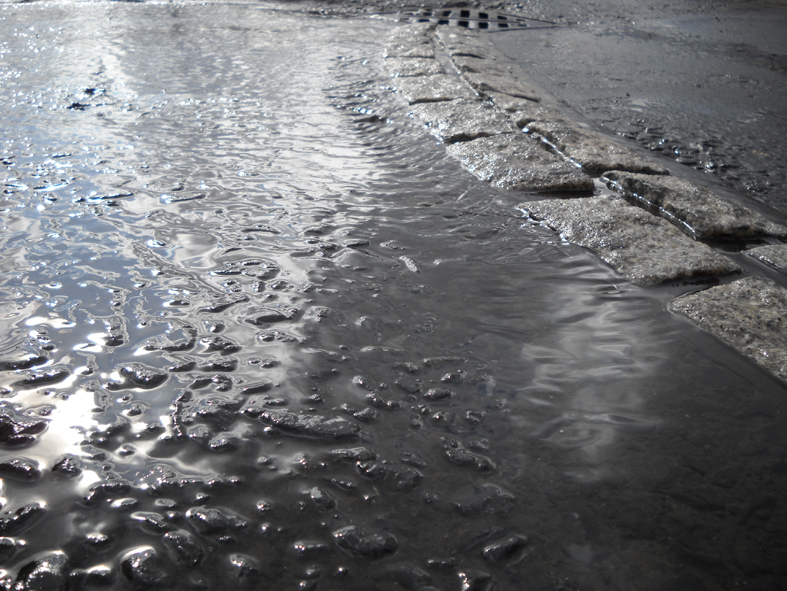
The Case for Cobbled Water Channels
And the good news is: there is. Cobbled water channels offer a genuine heritage-friendly solution that gets the job done while keeping the character of the streetscape intact.
Aesthetics First. Cobbled channels just look right at home. Made from the same materials as the surrounding landscape, they’ve got the same texture, the same colour variation, the same sense of history that makes a place feel special. They don’t scream “drainage” they whisper “quality”.
Built to Last. Cobbled channels are built to withstand the rough and tumble of life in the city. They can take a beating, whether it’s from traffic, winter maintenance or just the general wear and tear. They won’t crack, fade or fall apart like some of the alternatives.
Easy to Maintain. If a cobble gets damaged, it’s easy to swap it out. The channel can be cleaned and fixed without messing up the surrounding streetscape. It’s a system that’s designed for the long haul.
Integration is Key. Cobbled channels can be part of a much bigger picture – a public realm design that looks and feels like it belongs in the area. They can work alongside other heritage-friendly features like speed tables, gateway treatments and all sorts of traditional paving.
Sustainability too. Cobbled channels are pretty eco-friendly. They’re made from natural materials, and they can be part of a SuDS scheme if that’s what’s needed.
The Quicksetts Solution
Quicksetts water channels are made by Jobling Purser, using their high-quality resin-bound material – the same stuff they use to make their popular paving ranges. They look just like traditional granite setts, but they’re engineered for the demands of modern drainage.
They divert rainwater away from low-lying areas and into existing drainage systems. They’re surface-mounted, which means you don’t have to dig up the road to install them – a big plus in heritage areas where archaeology is a concern. And the best part is, they’re a real doddle to install – laid in a day, opened to traffic in hours. Much less disruption for local businesses and residents.
And let’s not forget how good they look. They enhance the streetscape rather than spoiling it.
A growing recognition that Aesthetics Matter
There’s a growing sense in the highways industry that if it looks ugly, it’s probably not worth doing. The days of slapping up some cheap, nasty drainage and calling it good are numbered.
The CIHT has come out in favour of SuDS, highlighting their value in terms of amenity and biodiversity. The Greater London Authority has a guide on rethinking how we handle rainwater in our streets. And Historic England has guidance on how SU DS can affect the historic environment.
The message is clear: drainage schemes need to respect the character of heritage areas. And that’s not just about aesthetics for their own sake. It’s about creating places that people actually want to be. Places that make them feel good about themselves and the world around them.
The Way Forward
So what’s the bottom line? When you’re specifying drainage in a heritage setting, you need to think about what you’re installing. Cheap and nasty solutions are not only a visual eye-sore but also a missed opportunity.
Cobbled water channels offer a genuine heritage-friendly solution that gets the job done, looks good and lasts for years. And that’s what we should be aiming for in our public realm.
Quicksetts water channels – the latest evolution in drainage design – are bringing the beauty of traditional granite setts into the 21st century with a modern engineering twist. These are surface-mounted, easy peasy to install, and built to withstand the test of time.
In an age where we’re finally starting to put our money where our mouth is when it comes to the quality of our public spaces, Quicksetts are just the ticket.
We get that “heritage” doesn’t mean locking everything in aspic. It’s about having a healthy respect for where we’ve come from, while still pushing forward with something new. And sometimes the best way to do that is to use materials that blend seamlessly into the existing landscape – even if they’re solving some pretty modern problems.
For a chat about how Quicksetts might fit into your project – and how you can get them specified – give Jobling Purser a shout.